
林宥呈
5 May 2026
討論區
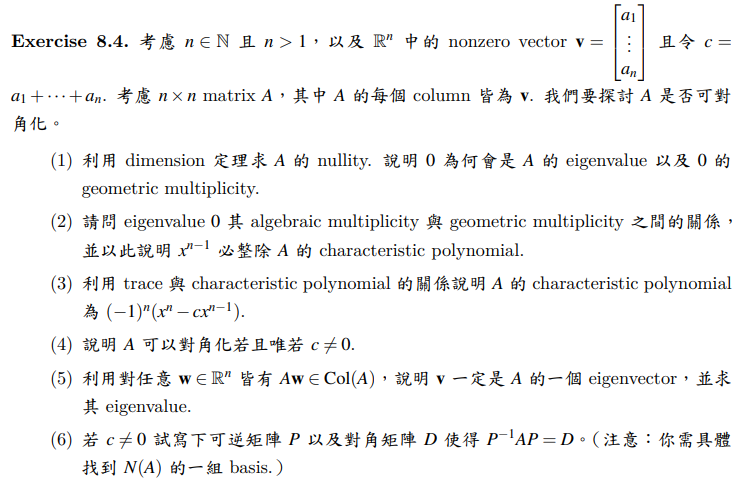


參考解答 (1)
因為 \(n \times n\) 矩陣 \(A\) 的每一個 colomn 皆為 \(\mathbf{v}=\begin{bmatrix} a_1 \\ a_2 \\ \vdots \\ a_n \end{bmatrix}\)
所以 \(A\) 的 column space 為 \(\mathrm{Span}(\mathbf{v},\ \mathbf{v},\ \dots,\ \mathbf{v})=\mathrm{Span}(\mathbf{v})\) ,因此 \(\mathrm{rank}(A)=1\)
由 dimension 定理: \(\mathrm{rank}(A)+\mathrm{nullity}(A)=n\) ,因此 \(\mathrm{nullity}(A)=n-1\)
因為 \(\mathrm{rank}(A)=1<n\) ,所以 \(A\) 不可逆,故 \(\det(A)=0 \Rightarrow \det(A-0I)=0\) ,從而 \(0\) 是 \(A\) 的一個 eigenvalue
而 \(0\) 的 geometric multiplicity 即為 \(\mathrm{dim}(E_A(0))=\mathrm{nullity}(A-0I)=\mathrm{nullity}(A)=n-1\)

回覆
回覆 晴月夢:
我原本寫證明時有注意到這點,以為題目有說就毋需特別說明,後來想想,其實你說得對,應該再額外說明 \(\mathbf{v}\ne\mathbf{0}\) 比較完整,否則單看原本的論述會令人誤以為無論 \(\mathbf{v}\) 是任何向量,都有 \(\mathrm{rank}(A)=1\)
參考解答 (1) 的更正如下:
因為 \(n \times n\) 矩陣 \(A\) 的每一個 colomn 皆為 \(\mathbf{v}=\begin{bmatrix} a_1 \\ a_2 \\ \vdots \\ a_n \end{bmatrix}\ne\mathbf{0}\)
所以 \(A\) 的 column space 為 \(\mathrm{Span}(\mathbf{v},\ \mathbf{v},\ \dots,\ \mathbf{v})=\mathrm{Span}(\mathbf{v})\) ,因此 \(\mathrm{rank}(A)=1\)
由 dimension 定理: \(\mathrm{rank}(A)+\mathrm{nullity}(A)=n\) ,因此 \(\mathrm{nullity}(A)=n-1\)
因為 \(\mathrm{rank}(A)=1<n\) ,所以 \(A\) 不可逆,故 \(\det(A)=0 \Rightarrow \det(A-0I)=0\) ,從而 \(0\) 是 \(A\) 的一個 eigenvalue
而 \(0\) 的 geometric multiplicity 即為 \(\mathrm{dim}(E_A(0))=\mathrm{nullity}(A-0I)=\mathrm{nullity}(A)=n-1\)
(6) 參考答案
\[
\text{取 }N(A)\text{ 的一組 basis:}
\]
\[
u_1=
\begin{bmatrix}
1\\
-1\\
0\\
\vdots\\
0
\end{bmatrix},
\quad
u_2=
\begin{bmatrix}
1\\
0\\
-1\\
\vdots\\
0
\end{bmatrix},
\quad
\cdots,
\quad
u_{n-1}=
\begin{bmatrix}
1\\
0\\
\vdots\\
0\\
-1
\end{bmatrix}.
\]
\[
Au_i=\mathbf 0.
\]
\[
\text{再取最後一個 eigenvector 為 }\mathbf v.
\]
\[
\text{令}
\quad
P=
\begin{bmatrix}
1 & 1 & \cdots & 1 & a_1\\
-1 & 0 & \cdots & 0 & a_2\\
0 & -1 & \cdots & 0 & a_3\\
\vdots & \vdots & \ddots & \vdots & \vdots\\
0 & 0 & \cdots & -1 & a_n
\end{bmatrix}
=
\begin{bmatrix}
u_1 & u_2 & \cdots & u_{n-1} & \mathbf v
\end{bmatrix}.
\]
\[
\text{這 }n\text{ 個向量 linearly independent,故 }P\text{ 可逆。}
\]
\[
\quad
D=
\begin{bmatrix}
0 & 0 & \cdots & 0 & 0\\
0 & 0 & \cdots & 0 & 0\\
\vdots & \vdots & \ddots & \vdots & \vdots\\
0 & 0 & \cdots & 0 & 0\\
0 & 0 & \cdots & 0 & c
\end{bmatrix}.
\]
\[
\text{因此}
\quad
P^{-1}AP=D.
\]