
討論區

建議(1)&參考解答(3)
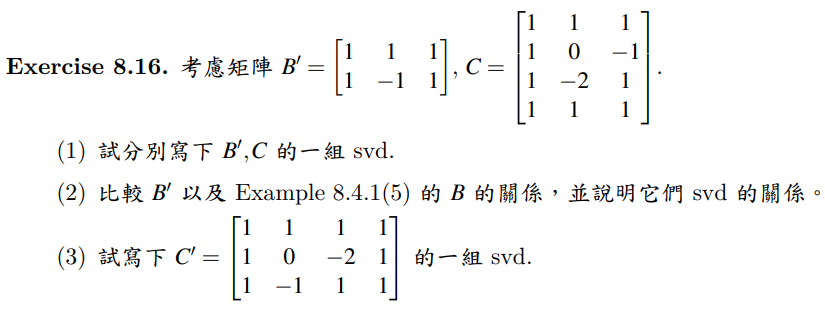
補充C的部分(’參考解答‘以外,好像沒強制規定要用latax,所以先用手寫上傳)
(3) $C' = C^t$, by (2) 結論, $C^t = (U_c \Sigma_c V_c^t)^t = V_c \Sigma_c^t U_c^t$
= $\begin{bmatrix} \frac{1}{\sqrt{2}} & \frac{1}{\sqrt{2}} & 0 \\ 0 & 0 & 1 \\ -\frac{1}{\sqrt{2}} & \frac{1}{\sqrt{2}} & 0 \end{bmatrix} $$\begin{bmatrix} \sqrt{2} & 0 & 0 & 0 \\ 0 & \sqrt{6} & 0 & 0 \\ 0 & 0 & \sqrt{6} & 0 \end{bmatrix} $$\begin{bmatrix} 0 & 1 & 0 & 0 \\ \frac{1}{\sqrt{3}} & 0 & \frac{1}{\sqrt{3}} & \frac{1}{\sqrt{3}} \\ \frac{1}{\sqrt{6}} & 0 & -\frac{2}{\sqrt{6}} & \frac{1}{\sqrt{6}} \\ \frac{1}{\sqrt{2}} & 0 & 0 & -\frac{1}{\sqrt{2}} \end{bmatrix}$
回覆
To 老師:
由 \(A=U\Sigma V^t\) 得到 \(A^t=(V^t)^t\Sigma^t U^t\)
並且因為 \(U,V\) 是 orthogonal matrices ,他們的轉置 \(U^t,V^t\) 也是 orthogonal matrices;因為 \(A\) 與 \(\Sigma\)的形狀一樣,他們的轉置 \(A^t\) 與 \(\Sigma^t\) 的形狀也一樣,且 \(\Sigma^t\) 只會有對角線上有由大到小的 \(\sigma_1, \sigma_2, \dots, \sigma_r\),其餘都為 \(0\)
以上三個矩陣都滿足 SVD 的模式,所以 \(A^t=(V^t)^t\Sigma^t U^t=V\Sigma^t U^t\) 是 \(A^t\) 的一組 SVD
建議 (1) & 參考解答 (2)
前言:
第一小題,我只寫了一組 \(B'\) 的 SVD,另外一個矩陣 \(C\) 雖然有做出來,但使用 \(\LaTeX\) 打這麼多矩陣有點過於麻煩,因此我先寫到這邊為止
第二小題,由於與前一部分高度相關,因此也順便寫出來
建議 (1):
首先確認 SVD 中 \(B'=U \Sigma V^t\) 中的 \(U,\Sigma, V\) 分別是什麼形狀的矩陣
因為 \(B'\) 為 \(2 \times 3\) 矩陣,所以 \(U\) 應為 \(2 \times 2\) 、\(\Sigma\) 應為 \(2 \times 3\) 且 \(V\) 應為 \(3 \times 3\) 矩陣
求 \(V\)
\((B')^tB'=\begin{bmatrix} 1 & 1 \\ 1 & -1 \\ 1 & 1 \end{bmatrix} \begin{bmatrix} 1 & 1 & 1 \\ 1 & -1 & 1 \end{bmatrix}=\begin{bmatrix} 2 & 0 & 2 \\ 0 & 2 & 0 \\ 2 & 0 & 2 \end{bmatrix}\)
\(\det((B')^tB'-tI)=\det \left(\begin{bmatrix} 2-t & 0 & 2 \\ 0 & 2-t & 0 \\ 2 & 0 & 2-t \end{bmatrix}\right)=(2-t)^3-4(2-t)=(2-t)[(2-t)^2-4]=-t(2-t)(4-t)\)
\(\implies \lambda_1=4, \lambda_2=2, \lambda_3=0\) 是 \((B')^tB'\) 的 eigenvalues
\(\lambda_1=4\) 對應的 eigenvector:
\((B')^tB'-4I=\begin{bmatrix} -2 & 0 & 2 \\ 0 & -2 & 0 \\ 2 & 0 & -2 \end{bmatrix} \sim \begin{bmatrix} -2 & 0 & 2 \\ 0 & -2 & 0 \\ 0 & 0 & 0\end{bmatrix}\)
\(\implies t\begin{bmatrix} 1 \\ 0 \\ 1 \end{bmatrix} (t \ne 0)\) 為 \(\lambda_1=4\) 對應的 eigenvector
取 \(\mathbf{v}_1=\frac{1}{\sqrt{1^2+0^2+1^2}} \begin{bmatrix} 1 \\ 0 \\ 1 \end{bmatrix}=\begin{bmatrix} \frac{1}{\sqrt{2}} \\ 0 \\ \frac{1}{\sqrt{2}} \end{bmatrix}\)
\(\lambda_2=2\) 對應的 eigenvector:
\((B')^tB'-2I=\begin{bmatrix} 0 & 0 & 2 \\ 0 & 0 & 0 \\ 2 & 0 & 0 \end{bmatrix}\)
\(\implies t\begin{bmatrix} 0 \\ 1 \\ 0 \end{bmatrix} (t \ne 0)\) 為 \(\lambda_2=2\) 對應的 eigenvector
取 \(\mathbf{v}_2=\frac{1}{\sqrt{0^2+1^2+0^2}} \begin{bmatrix} 0 \\ 1 \\ 0 \end{bmatrix}=\begin{bmatrix} 0 \\ 1 \\ 0 \end{bmatrix}\)
\(\lambda_3=0\) 對應的 eigenvector:
\((B')^tB'-0I=\begin{bmatrix} 2 & 0 & 2 \\ 0 & 2 & 0 \\ 2 & 0 & 2 \end{bmatrix} \sim \begin{bmatrix} 2 & 0 & 2 \\ 0 & 2 & 0 \\ 0 & 0 & 0 \end{bmatrix}\)
\(\implies t\begin{bmatrix} 1 \\ 0 \\ -1 \end{bmatrix} (t \ne 0)\) 為 \(\lambda_3=0\) 對應的 eigenvector
取 \(\mathbf{v}_3=\frac{1}{\sqrt{1^2+0^2+1^2}} \begin{bmatrix} 1 \\ 0 \\ -1 \end{bmatrix}=\begin{bmatrix} \frac{1}{\sqrt{2}} \\ 0 \\ -\frac{1}{\sqrt{2}} \end{bmatrix}\)
\(\implies V=\begin{bmatrix} \frac{1}{\sqrt{2}} & 0 & \frac{1}{\sqrt{2}} \\ 0 & 1 & 0 \\ \frac{1}{\sqrt{2}} & 0 & -\frac{1}{\sqrt{2}}\end{bmatrix}\)
求 \(\Sigma\)
由 \(\lambda_1=4, \lambda_2=2, \lambda_3=0\) 可以得到 \(\sigma_1=\sqrt{4}=2, \sigma_2=\sqrt{2}, \sigma_3=\sqrt{0}=0\)
\(\implies \Sigma = \begin{bmatrix} 2 & 0 & 0 \\ 0 & \sqrt{2} & 0 \end{bmatrix}\)
求 \(U\)
\(\mathbf{u}_1=\frac{1}{\sigma_1} B' \mathbf{v}_1=\frac{1}{2} \begin{bmatrix} 1 & 1 & 1 \\ 1 & -1 & 1 \end{bmatrix} \begin{bmatrix} \frac{1}{\sqrt{2}} \\ 0 \\ \frac{1}{\sqrt{2}} \end{bmatrix}=\begin{bmatrix} \frac{1}{\sqrt{2}} \\ \frac{1}{\sqrt{2}} \end{bmatrix}\)
\(\mathbf{u}_2=\frac{1}{\sigma_2} B' \mathbf{v}_2=\frac{1}{\sqrt{2}} \begin{bmatrix} 1 & 1 & 1 \\ 1 & -1 & 1 \end{bmatrix} \begin{bmatrix} 0 \\ 1 \\ 0 \end{bmatrix}=\begin{bmatrix} \frac{1}{\sqrt{2}} \\ -\frac{1}{\sqrt{2}} \end{bmatrix}\)
\(\implies U=\begin{bmatrix} \frac{1}{\sqrt{2}} & \frac{1}{\sqrt{2}} \\ \frac{1}{\sqrt{2}} & -\frac{1}{\sqrt{2}}\end{bmatrix}\)
故 \(B'\) 的一組 SVD 為 \(B'=\begin{bmatrix} \frac{1}{\sqrt{2}} & \frac{1}{\sqrt{2}} \\ \frac{1}{\sqrt{2}} & -\frac{1}{\sqrt{2}}\end{bmatrix} \begin{bmatrix} 2 & 0 & 0 \\ 0 & \sqrt{2} & 0 \end{bmatrix} \begin{bmatrix} \frac{1}{\sqrt{2}} & 0 & \frac{1}{\sqrt{2}} \\ 0 & 1 & 0 \\ \frac{1}{\sqrt{2}} & 0 & -\frac{1}{\sqrt{2}}\end{bmatrix}\)
參考解答 (2):
Example 8.4.1(5) 的情況:
\(B=\begin{bmatrix} 1 &1 \\ 1 & -1 \\ 1 & 1 \end{bmatrix}\) 且其 SVD 為 \(B=U_B \Sigma_B V_B^t=\begin{bmatrix} \frac{1}{\sqrt{2}} & 0 & \frac{1}{\sqrt{2}} \\ 0 & 1 & 0 \\ \frac{1}{\sqrt{2}} & 0 & -\frac{1}{\sqrt{2}}\end{bmatrix} \begin{bmatrix} 2 &0 \\ 0 & \sqrt{2} \\ 0 & 0 \end{bmatrix} \begin{bmatrix} \frac{1}{\sqrt{2}} & \frac{1}{\sqrt{2}} \\ \frac{1}{\sqrt{2}} & -\frac{1}{\sqrt{2}}\end{bmatrix}\)
(為了避免符號重複,我改了原題的符號,原本的 \(U\) 是以上的 \(U_B\) ,依此類推)
\(B'\) 與 \(B\) 的關係:\(B'=B^t\)
\(B'\) 的 SVD 與 \(B\) 的 SVD 的關係:\(U \Sigma V = V_B\Sigma_B^t U_B^t \)
原因: