
討論區

(2) 提問
\[
\quad
B=
\begin{bmatrix}
1 & 0 & 0\\
1 & 1 & 0\\
1 & 1 & 1
\end{bmatrix}
\to
\text{echelon form}
\to
\begin{bmatrix}
1 & 0 & 0\\
0 & 1 & 0\\
0 & 0 & 1
\end{bmatrix}
\]
\[
\therefore\ R(T_2)\text{ 的 basis 是 }
\begin{pmatrix}
1\\
1\\
1
\end{pmatrix},
\begin{pmatrix}
0\\
1\\
1
\end{pmatrix},
\begin{pmatrix}
0\\
0\\
1
\end{pmatrix}
\]
\[
N(T_2)\text{ 沒有 basis}
\]
(2) 參考答案
我不知道之前我在寫什麼,應該要用\(\beta\)表示,但我用標準基底表示就不是那個表現矩陣
\[
\text{(2) 利用 }
\left\{
\begin{pmatrix}
1\\
1\\
1
\end{pmatrix},
\begin{pmatrix}
0\\
1\\
1
\end{pmatrix},
\begin{pmatrix}
0\\
0\\
1
\end{pmatrix}
\right\}
\text{ 之這組 ordered basis 表示}
\]
\[
e_1=
\begin{pmatrix}
1\\
0\\
0
\end{pmatrix}
=
1
\begin{pmatrix}
1\\
1\\
1
\end{pmatrix}
-1
\begin{pmatrix}
0\\
1\\
1
\end{pmatrix}
+0
\begin{pmatrix}
0\\
0\\
1
\end{pmatrix}
\]
所以 \([T_2]\) 第一個 column 為
\[
\begin{pmatrix}
1\\
-1\\
0
\end{pmatrix}.
\]
\[
e_2=
\begin{pmatrix}
0\\
1\\
0
\end{pmatrix}
=
0
\begin{pmatrix}
1\\
1\\
1
\end{pmatrix}
+1
\begin{pmatrix}
0\\
1\\
1
\end{pmatrix}
-1
\begin{pmatrix}
0\\
0\\
1
\end{pmatrix}
\]
第二個 column 為
\[
\begin{pmatrix}
0\\
1\\
-1
\end{pmatrix}.
\]
\[
e_3=
\begin{pmatrix}
0\\
0\\
1
\end{pmatrix}
=
0
\begin{pmatrix}
1\\
1\\
1
\end{pmatrix}
+0
\begin{pmatrix}
0\\
1\\
1
\end{pmatrix}
+1
\begin{pmatrix}
0\\
0\\
1
\end{pmatrix}
\]
第三個 column 為
\[
\begin{pmatrix}
0\\
0\\
1
\end{pmatrix}.
\]
因此
\[
[T_2]=
\begin{bmatrix}
1 & 0 & 0\\
-1 & 1 & 0\\
0 & -1 & 1
\end{bmatrix}
\]
化成 echelon form:
\[
\begin{bmatrix}
1 & 0 & 0\\
-1 & 1 & 0\\
0 & -1 & 1
\end{bmatrix}
\sim
\begin{bmatrix}
1 & 0 & 0\\
0 & 1 & 0\\
0 & 0 & 1
\end{bmatrix}.
\]
Image basis:
\[
\left\{
\begin{pmatrix}
1\\
-1\\
0
\end{pmatrix},
\begin{pmatrix}
0\\
1\\
-1
\end{pmatrix},
\begin{pmatrix}
0\\
0\\
1
\end{pmatrix}
\right\}
\]
kernel 沒有 basis
(2)參考解答
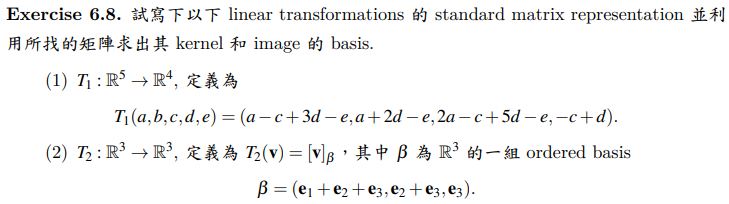
令 $\beta = \{ \mathbf{v}_1, \mathbf{v}_2, \mathbf{v}_3 \} = \{ \mathbf{e}_1 + \mathbf{e}_2 + \mathbf{e}_3, \mathbf{e}_2 + \mathbf{e}_3, \mathbf{e}_3 \} = \left\{ \begin{pmatrix} 1 \\ 1 \\ 1 \end{pmatrix}, \begin{pmatrix} 0 \\ 1 \\ 1 \end{pmatrix}, \begin{pmatrix} 0 \\ 0 \\ 1 \end{pmatrix} \right\}$
$T_2(\mathbf{e}_1) = [\mathbf{e}_1]_\beta = 1 \cdot \mathbf{v}_1 + (-1) \cdot \mathbf{v}_2 + 0 \cdot \mathbf{v}_3 \implies T_2(\mathbf{e}_1) = \begin{pmatrix} 1 \\ -1 \\ 0 \end{pmatrix}$
$T_2(\mathbf{e}_2) = [\mathbf{e}_2]_\beta = 0 \cdot \mathbf{v}_1 + 1 \cdot \mathbf{v}_2 + (-1) \cdot \mathbf{v}_3 \implies T_2(\mathbf{e}_2) = \begin{pmatrix} 0 \\ 1 \\ -1 \end{pmatrix}$
$T_2(\mathbf{e}_3) = [\mathbf{e}_3]_\beta = 0 \cdot \mathbf{v}_1 + 0 \cdot \mathbf{v}_2 + 1 \cdot \mathbf{v}_3 \implies T_2(\mathbf{e}_3) = \begin{pmatrix} 0 \\ 0 \\ 1 \end{pmatrix}$
因此得到表現矩陣$[T_2] = \begin{pmatrix} 1 & 0 & 0 \\ -1 & 1 & 0 \\ 0 & -1 & 1 \end{pmatrix}$
由於 $T_2: \mathbb{R}^3 \to \mathbb{R}^3$,依照定義有$T_2(\mathbf{v}) = [\mathbf{v}]_\beta$。根據定理,$T_2$ 為linear transformation,且為onto與one-to-one。
(i)因為 $T_2$ 為 one-to-one,其$N(T_2) = \{ \mathbf{0} \}$,故 $N(T_2)$ 的basis為空集合 $\emptyset$。
(ii)因為 $T_2$ 為 onto,其$R(T_2) = \mathbb{R}^3$,故可找到 $R(T_2)$ 的一組基底為 $\{ \mathbf{e}_1, \mathbf{e}_2, \mathbf{e}_3 \} = \left\{ \begin{pmatrix} 1 \\ 0 \\ 0 \end{pmatrix}, \begin{pmatrix} 0 \\ 1 \\ 0 \end{pmatrix}, \begin{pmatrix} 0 \\ 0 \\ 1 \end{pmatrix} \right\}$。
(1) 參考答案
\[
T_1(a,b,c,d,e)
=
(a-c+3d-e,\ a+2d-e,\ 2a-c+5d-e,\ -c+d).
\]
取標準基底 \(e_1,e_2,e_3,e_4,e_5\):
\[
T_1(e_1)=(1,1,2,0),\quad
T_1(e_2)=(0,0,0,0),\quad
T_1(e_3)=(-1,0,-1,-1),
\]
\[
T_1(e_4)=(3,2,5,1),\quad
T_1(e_5)=(-1,-1,-1,0).
\]
故標準矩陣為
\[
A=
\begin{bmatrix}
1 & 0 & -1 & 3 & -1\\
1 & 0 & 0 & 2 & -1\\
2 & 0 & -1 & 5 & -1\\
0 & 0 & -1 & 1 & 0
\end{bmatrix}.
\]
\[
A=
\begin{bmatrix}
1 & 0 & -1 & 3 & -1\\
1 & 0 & 0 & 2 & -1\\
2 & 0 & -1 & 5 & -1\\
0 & 0 & -1 & 1 & 0
\end{bmatrix}
\to
\text{echelon form}
\to
\begin{bmatrix}
1 & 0 & -1 & 3 & -1\\
0 & 0 & 1 & -1 & 0\\
0 & 0 & 0 & 0 & 1\\
0 & 0 & 0 & 0 & 0
\end{bmatrix}
\]
\[
R(T)\text{ 的 basis 是 }
\begin{pmatrix}
1\\
1\\
2\\
0
\end{pmatrix},
\begin{pmatrix}
-1\\
0\\
-1\\
-1
\end{pmatrix},
\begin{pmatrix}
-1\\
-1\\
-1\\
0
\end{pmatrix}
\]
\[
N(T)\text{ 的第2和第4個變數為 free variable,分別給 }(1,0),( 0,1 )
\]
\[
\text{得 }N(T)\text{ 的 basis 是 }
\begin{pmatrix}
0\\
1\\
0\\
0\\
0
\end{pmatrix}
\text{ 和 }
\begin{pmatrix}
-2\\
0\\
1\\
1\\
0
\end{pmatrix}
\]