
討論區
(3)我真的沒辦法 請各位傳承我的精神繼續把(3)做完

建議
這是第三題 \[
\text{當}\quad n=3
\]
\[
f(x)=
\begin{bmatrix}
1 & c_1 & c_1^2\\
1 & c_2 & c_2^2\\
1 & x & x^2
\end{bmatrix}
\]
最高次項為 $(c_2-c_1)x^2$,結論成立。
假設 $n=k$ 時藉由歸納法,已知
\[
\prod_{1\le i<j\le k-1}(c_j-c_i)\,x^{k-1}
\]
是 $f(x)$ 的最高次項。
則當 $n=k+1$ 時,$f(x)$ 展開後的第 $k+1$ 列為
\[
1,x,x^2,\dots,x^k
\]
對第 $k+1$ 列作展開,則只有最後對應 $x^k$ 展開時會給出最高次項,
其係數是
\[
(-1)^{k+1+k+1}=1
\]
乘上當 $n=k$ 時的子式值。
而當 $n=k$ 時的子式,其最高次項又可寫成
\[
\prod_{1\le i<j\le k-1}(c_j-c_i)x^{k-1},
\]
故由數學歸納法得知,對所有 $\ge 3$ 的正整數 $n$,
$f(x)$ 的最高次項為
\[
\prod_{1\le i<j\le n-1}(c_j-c_i)x^{n-1}.
\]
當 $x=c_i$(其中 $i=1,\dots,n-1$)時,矩陣有兩列相同,
行列式為0,所以 $f(x)$ 有 $n-1$ 個根
\[
c_1,c_2,\dots,c_{n-1}.
\]
代入 $x=c_n$ 至 $f(x)$,
\[
\begin{bmatrix}
1 & c_1 & c_1^2 & \cdots & c_1^{n-1}\\
1 & c_2 & c_2^2 & \cdots & c_2^{n-1}\\
\vdots & \vdots & \vdots & & \vdots\\
1 & c_n & c_n^2 & \cdots & c_n^{n-1}
\end{bmatrix}
=
\prod_{1\le i<j\le n}(c_j-c_i).
\]

正確使用數學歸納法
在 Exercise 5.6 的討論中,提及數學歸納法需明確表示歸納假設 $n=k$ 和要論述的 $n=k+1$ 之間的關係。本題的歸納假設到底是關於多項式的最高次項係數還是所求矩陣的行列式呢?就拿由 $n=2$ 推到 $n=3$ 來說,若是要利用最高次項係數來當歸納假設,那表示將矩陣分割成 $\left[\begin{array}{cc|c} 1&c_1&c_1^2\\ \hline 1&c_2&c_2^2\\1&x&x^2\end{array}\right]$ 這樣才有可能從 $n=2$ 的多項式去推 $n=3$ 的多項式;而若考慮兩個行列式的關係,則應將陣分割成 $\left[\begin{array}{cc|c} 1&c_1&c_1^2\\1&c_2&c_2^2\\ \hline 1&x&x^2\end{array}\right]$,這樣才有機會利用 (1)(2)小題的推論過程推出 $n=3$ 的行列式。大家覺得哪一個可行?
回覆+參考解答
對於老師的問題,我的答案是將矩陣分割成第二種形式,才有機會從 $n=k$ 的行列式推得 $n=k+1$ 行列式,因此在推導過程中,我注意到我們可以從假設上先去下手,先推得其矩陣行列式的關係再沿用到 $n=k+1$ 的情況,注意到要分割成老師提到的第二種形式,在 det 的性質上,我們可以對 $k+1$-th row 進行降階,使其行列式可以使用 $n=k$ 中的假設去動手,你們可以透過我下方的解法去看看我的想法:
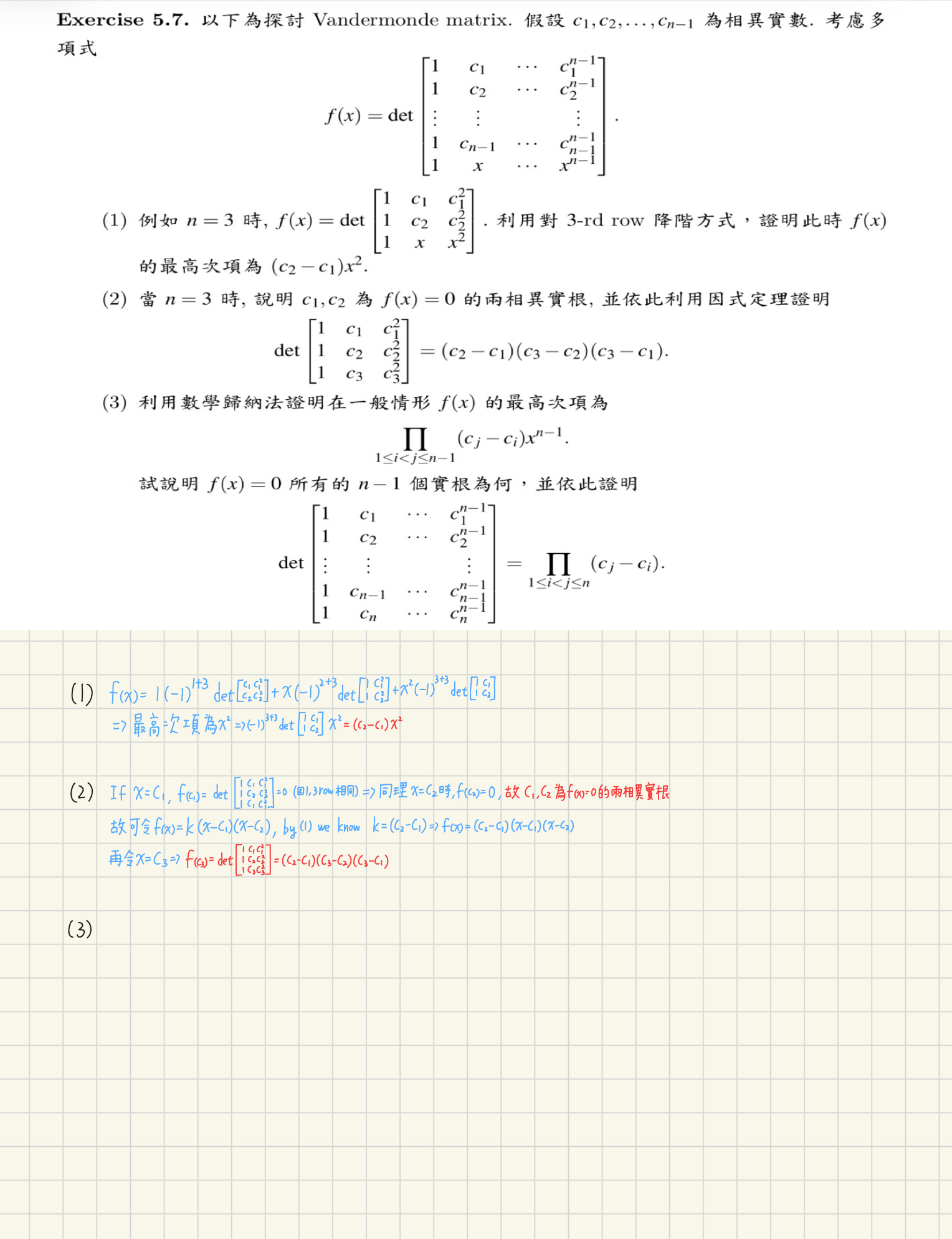
(1) 當 $n=3$ 時,
\[
f(x) = \det \begin{bmatrix}
1 & c_1 & c_1^2 \\
1 & c_2 & c_2^2 \\
1 & x & x^2
\end{bmatrix}
\]
按 $3$-rd row 展開:
\[
f(x) = 1 \cdot \det \begin{bmatrix} c_1 & c_1^2 \\ c_2 & c_2^2 \end{bmatrix}
- x \cdot \det \begin{bmatrix} 1 & c_1^2 \\ 1 & c_2^2 \end{bmatrix}
+ x^2 \cdot \det \begin{bmatrix} 1 & c_1 \\ 1 & c_2 \end{bmatrix}
\]
此時,$f(x)$ 的最高次項為 $(c_2 - c_1)x^2$。
(2) 因
\[
f(c_1) = \det \begin{bmatrix} 1 & c_1 & c_1^2 \\ 1 & c_2 & c_2^2 \\ 1 & c_1 & c_1^2 \end{bmatrix} = 0, \quad
f(c_2) = \det \begin{bmatrix} 1 & c_1 & c_1^2 \\ 1 & c_2 & c_2^2 \\ 1 & c_2 & c_2^2 \end{bmatrix} = 0
\]
$\therefore c_1, c_2$ 為 $f(x)=0$ 的兩相異實根。
By 因式定理:
\[
f(x) = k(x - c_1)(x - c_2)
\]
又最高次項為 $(c_2 - c_1)x^2$,故 $k = (c_2 - c_1)$
\[
\therefore f(x) = (c_2 - c_1)(x - c_1)(x - c_2)
\]
代入 $x = c_3$ 得:
\[
\det \begin{bmatrix} 1 & c_1 & c_1^2 \\ 1 & c_2 & c_2^2 \\ 1 & c_3 & c_3^2 \end{bmatrix}
= (c_2 - c_1)(c_3 - c_2)(c_3 - c_1)
\]
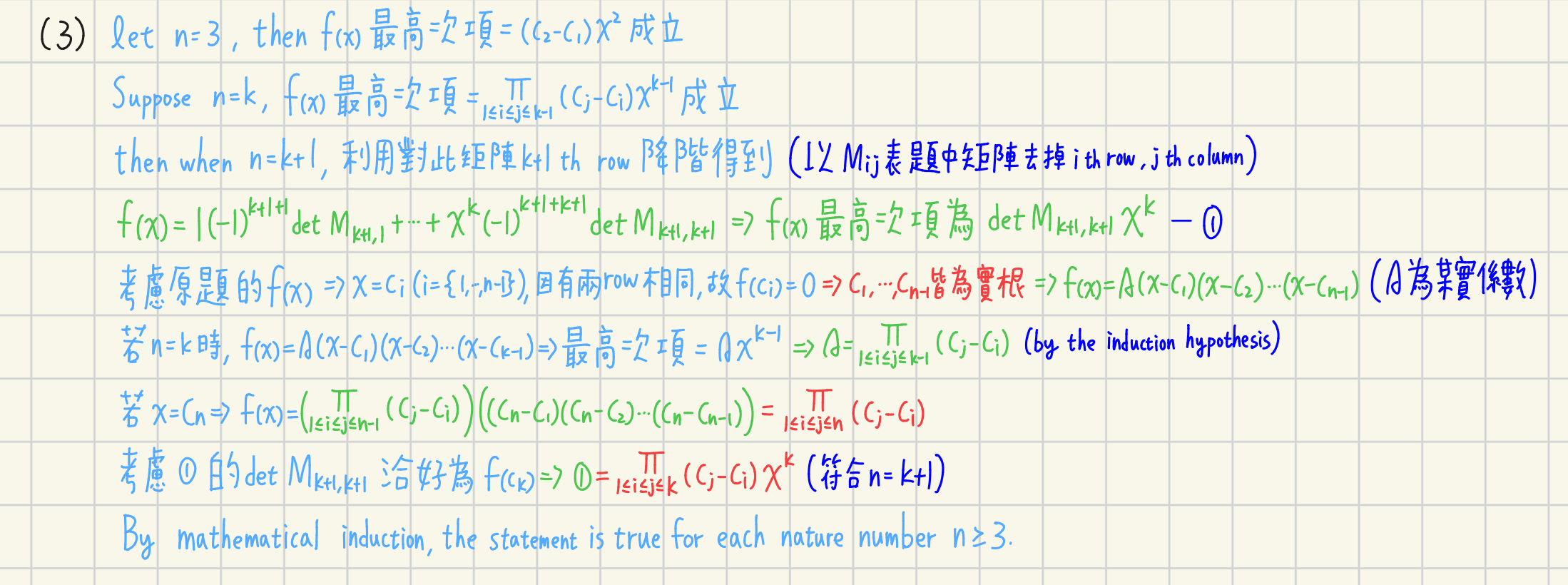
(3) 令 $P(n)$ :$f(x)$ 的最高次項為 $\displaystyle\prod_{1 \le i < j \le n-1} (c_j - c_i) x^{n-1}$。
$n=3$ 時:由 (1) 知 $P(3)$ 成立。
假設 $n=k$ 時,$P(k)$ 成立,
即若
\[
f(x) = \det \begin{bmatrix}
1 & c_1 & \dots & c_1^{k-1} \\
\vdots & \vdots & \ddots & \vdots \\
1 & c_{k-1} & \dots & c_{k-1}^{k-1} \\
1 & x & \dots & x^{k-1}
\end{bmatrix}
\]
則 $f(x)$ 的最高次項為 $\displaystyle\prod_{1 \le i < j \le k-1} (c_j - c_i) x^{k-1}$,
且 $f(c_i) = 0, \forall i = 1, 2, \dots, k-1$。
則 By 因式定理:
\[
f(x) = k'(x - c_1)(x - c_2) \dots (x - c_{k-1})
\]
因 $f(x)$ 的最高次項係數為 $\displaystyle\prod_{1 \le i < j \le k-1} (c_j - c_i)$,
故 $k' = \displaystyle\prod_{1 \le i < j \le k-1} (c_j - c_i)$。
代入 $x = c_k$:
\[
f(c_k) = \prod_{1 \le i < j \le k-1} (c_j - c_i) \cdot (c_k - c_1)(c_k - c_2) \dots (c_k - c_{k-1})
= \prod_{1 \le i < j \le k} (c_j - c_i)
\]
那麼,當 $n=k+1$ 時:
若
\[
f(x) = \det \begin{bmatrix}
1 & c_1 & \dots & c_1^k \\
\vdots & \vdots & \ddots & \vdots \\
1 & c_k & \dots & c_k^k \\
1 & x & \dots & x^k
\end{bmatrix}
\]
按 $k+1$-th row 展開:
則 $f(x)$ 的最高次項為
\[
(-1)^{(k+1)+(k+1)} \cdot x^k \cdot \det \begin{bmatrix}
1 & c_1 & \dots & c_1^{k-1} \\
\vdots & \vdots & \ddots & \vdots \\
1 & c_k & \dots & c_k^{k-1}
\end{bmatrix}
\]
By 假設的結論,
\[
\det \begin{bmatrix}
1 & c_1 & \dots & c_1^{k-1} \\
\vdots & \vdots & \ddots & \vdots \\
1 & c_k & \dots & c_k^{k-1}
\end{bmatrix}
= f(c_k) = \prod_{1 \le i < j \le k} (c_j - c_i)
\]
故 $f(x)$ 的最高次項為 $\displaystyle\left( \prod_{1 \le i < j \le k} (c_j - c_i) \right) x^k$。
因此,$P(k+1)$ 亦成立。
$\therefore$ By 數學歸納法,$P(n)$ 對於 $n \in \mathbb{N}$ 且 $n \ge 3$ 皆成立。
因
\[
f(c_i) = \det \begin{bmatrix}
1 & c_1 & \dots & c_1^{n-1} \\
\vdots & \vdots & \ddots & \vdots \\
1 & c_{n-1} & \dots & c_{n-1}^{n-1} \\
1 & c_i & \dots & c_i^{n-1}
\end{bmatrix} = 0, \quad \forall i = 1, \dots, n-1
\]
By determinant 的性質知兩 rows 一樣,則行列式為 $0$,
故 $c_1, \dots, c_{n-1}$ 為 $f(x)=0$ 的 $n-1$ 個實根。
By 因式定理:
\[
f(x) = k'(x - c_1)(x - c_2) \dots (x - c_{n-1})
\]
因 $f(x)$ 的最高次項為 $\displaystyle\prod_{1 \le i < j \le n-1} (c_j - c_i)x^{n-1}$,
則 $k' = \displaystyle\prod_{1 \le i < j \le n-1} (c_j - c_i)$。
故
\[
f(x) = \prod_{1 \le i < j \le n-1} (c_j - c_i)(x - c_1)(x - c_2) \dots (x - c_{n-1})
\]
\[
f(c_n) = \det \begin{bmatrix}
1 & c_1 & \dots & c_1^{n-1} \\
\vdots & \vdots & \ddots & \vdots \\
1 & c_{n-1} & \dots & c_{n-1}^{n-1} \\
1 & c_n & \dots & c_n^{n-1}
\end{bmatrix}
= \prod_{1 \le i < j \le n-1} (c_j - c_i)(c_n - c_1)(c_n - c_2) \dots (c_n - c_{n-1})
= \prod_{1 \le i < j \le n} (c_j - c_i)
\]
前兩題已看完
包子入侵 前兩題我已看完,沒什麼問題,可以再思考一下第三題