
討論區
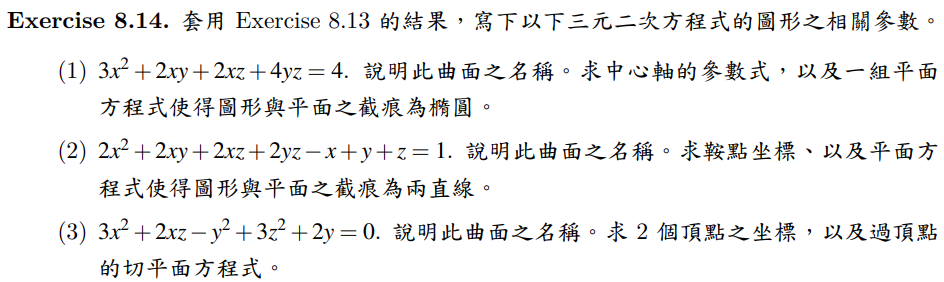
8.14(2)參考解答
首先根據 8.13(2) 的結果,令同學提供的正交矩陣為 $Q_B = \begin{bmatrix}
\frac{2}{\sqrt{6}} & -\frac{1}{\sqrt{3}} & 0 \\
\frac{1}{\sqrt{6}} & \frac{1}{\sqrt{3}} & -\frac{1}{\sqrt{2}} \\
\frac{1}{\sqrt{6}} & \frac{1}{\sqrt{3}} & \frac{1}{\sqrt{2}}
\end{bmatrix}$,並接下來以下說明:
1. 圖形 $2x^2 + 2xy + 2xz + 2yz - x + y + z = 1$ 經對角化後的未平移式子為 $3\bar{x}^2 - \bar{z}^2 + \sqrt{3}\bar{y} = 1$。
將方程式移項:
$$\sqrt{3}\left(\bar{y} - \frac{1}{\sqrt{3}}\right) = \bar{z}^2 - 3\bar{x}^2$$
此時,定義經偏移後的標準坐標 $(x', y', z')$ ,有
$$x' = \bar{x}, \quad y' = \bar{y} - \frac{1}{\sqrt{3}}, \quad z' = \bar{z}$$
代入後即可得到最終標準式為
$$3x'^2 - z'^2 + \sqrt{3}y' = 0 \implies \sqrt{3}y' = z'^2 - 3x'^2$$
此圖形為 hyperbolic paraboloid(雙曲拋物面)。
2. 雙曲拋物面的中心點在標準新坐標系中位於 $(x', y', z') = (0, 0, 0)$。而 $\bar{x} = 0, \bar{y} = \frac{1}{\sqrt{3}}, \bar{z} = 0$。
故中心點在原坐標 $(x, y, z)$為:
$$
\begin{bmatrix} x \\ y \\ z \end{bmatrix} = Q_B \begin{bmatrix} \bar{x} \\ \bar{y} \\ \bar{z} \end{bmatrix} = \begin{bmatrix}
\frac{2}{\sqrt{6}} & -\frac{1}{\sqrt{3}} & 0 \\
\frac{1}{\sqrt{6}} & \frac{1}{\sqrt{3}} & -\frac{1}{\sqrt{2}} \\
\frac{1}{\sqrt{6}} & \frac{1}{\sqrt{3}} & \frac{1}{\sqrt{2}}
\end{bmatrix} \begin{bmatrix} 0 \\ \frac{1}{\sqrt{3}} \\ 0 \end{bmatrix} = \begin{bmatrix} -\frac{1}{3} \\ \frac{1}{3} \\ \frac{1}{3} \end{bmatrix}
$$
3. 在標準新坐標系中,通過鞍點且切於該點的水平面(即 $y' = 0$ 平面),截雙曲拋物面,截面的圖形為兩相交直線。令平面 $y' = 0$(即平面在標準新坐標為 $x'z'$ 平面),與曲面相截都會得到兩直線:
$$
z'^2 - 3x'^2 = 0 \implies (z' - \sqrt{3}x')(z' + \sqrt{3}x') = 0
$$
而正交化性質有:
$$
\begin{bmatrix} \bar{x} \\ \bar{y} \\ \bar{z} \end{bmatrix} = Q_B^t \begin{bmatrix} x \\ y \\ z \end{bmatrix} = \begin{bmatrix} \frac{2}{\sqrt{6}} & \frac{1}{\sqrt{6}} & \frac{1}{\sqrt{6}} \\ -\frac{1}{\sqrt{3}} & \frac{1}{\sqrt{3}} & \frac{1}{\sqrt{3}} \\ 0 & -\frac{1}{\sqrt{2}} & \frac{1}{\sqrt{2}} \end{bmatrix} \begin{bmatrix} x \\ y \\ z \end{bmatrix}
$$
從矩陣第二列得到 $\bar{y} = -\frac{1}{\sqrt{3}}x + \frac{1}{\sqrt{3}}y + \frac{1}{\sqrt{3}}z$。將其代入 $\bar{y} = \frac{1}{\sqrt{3}}$,得到 $-\frac{1}{\sqrt{3}}x + \frac{1}{\sqrt{3}}y + \frac{1}{\sqrt{3}}z = \frac{1}{\sqrt{3}}$,故通過鞍點且切於該點的水平面,在原坐標的平面方程式為:
$$
-x + y + z = 1 \implies x - y - z + 1 = 0
$$
請注意
我們不希望同學用背的方式記憶這些圖形。請依照上課幫大家整理分類好的英文命名原則處理:計算出 eigenvalue 後,若皆不等於 $0$,請按讓新坐標的 $x,y$ 係數同號方式處理。而 eigenvalue 若有 $0$ ,請按讓 $z$、$y$ 係數為 $0$ 的順序。這樣可以讓中心軸永遠在 $z$ 軸,再用我們介紹的準則看 $x=0$, $y=0$ 所截曲線來判斷主體,並利用 $z=k$ 來形容其樣貌。也就是需說明判斷的方法,而不是直接背誦說出名稱。
另外為了閱卷方便,寫成標準式請不要除以常數項(否則常數項為 $0$ 怎麼辦?),請保留平方項係數皆為 eigenvalue 的形式。
8.14(1)參考解答
首先根據 8.13(1) 的結果,令 $Q_A = \begin{bmatrix}
0 & -\frac{1}{\sqrt{3}} & \frac{2}{\sqrt{6}} \\
\frac{1}{\sqrt{2}} & \frac{1}{\sqrt{3}} & \frac{1}{\sqrt{6}} \\
-\frac{1}{\sqrt{2}} & \frac{1}{\sqrt{3}} & \frac{1}{\sqrt{6}}
\end{bmatrix}$,並接下來以下說明:
1. 圖形 $3x^2 + 2xy + 2xz + 4yz = 4$ 的新座標標準式為 $-2\bar{x}^2 + \bar{y}^2 + 4\bar{z}^2 = 4 \implies \frac{\bar{y}^2}{4} + \bar{z}^2 - \frac{\bar{x}^2}{2} = 1$ ,此為 hyperboloid of one sheet(單葉雙曲面),中心在原點。
2. 單葉雙曲面的對稱軸(中心軸)是代表負號那一項的軸,也就是 $\bar{x}$ 軸。在 $\bar{x}$ 軸上,點的坐標滿足 $\bar{y} = 0$ 且 $\bar{z} = 0$,令中心軸參數式 $\bar{x} = t$ ($t \in \mathbb{R}$),故中心軸在原坐標為:
$$
\begin{bmatrix} x \\ y \\ z \end{bmatrix} = Q_A \begin{bmatrix} t \\ 0 \\ 0 \end{bmatrix} = \begin{bmatrix}
0 & -\frac{1}{\sqrt{3}} & \frac{2}{\sqrt{6}} \\
\frac{1}{\sqrt{2}} & \frac{1}{\sqrt{3}} & \frac{1}{\sqrt{6}} \\
-\frac{1}{\sqrt{2}} & \frac{1}{\sqrt{3}} & \frac{1}{\sqrt{6}}
\end{bmatrix} \begin{bmatrix} t \\ 0 \\ 0 \end{bmatrix} = \begin{bmatrix} 0 \\ \frac{1}{\sqrt{2}}t \\ -\frac{1}{\sqrt{2}}t \end{bmatrix}
$$
3. 在標準新坐標系中,垂直於中心軸($\bar{x}$ 軸)的平面,截單葉雙曲面,截面的圖形為橢圓。令平面 $\bar{x} = c$ ($c \in \mathbb{R}$),與曲面相截都會得到橢圓:
$$
\bar{y}^2 + 4\bar{z}^2 = 4 + 2c^2 \implies \frac{\bar{y}^2}{4 + 2c^2} + \frac{\bar{z}^2}{1 + \frac{c^2}{2}} = 1
$$
取 $c = 0$(即平面在新坐標為 $\bar{y}\bar{z}$ 平面,方程式為 $\bar{x} = 0$)。
而正交化性質有:
$$
\begin{bmatrix} \bar{x} \\ \bar{y} \\ \bar{z} \end{bmatrix} = Q_A^t \begin{bmatrix} x \\ y \\ z \end{bmatrix} = \begin{bmatrix} 0 & \frac{1}{\sqrt{2}} & -\frac{1}{\sqrt{2}} \\ -\frac{1}{\sqrt{3}} & \frac{1}{\sqrt{3}} & \frac{1}{\sqrt{3}} \\ \frac{2}{\sqrt{6}} & \frac{1}{\sqrt{6}} & \frac{1}{\sqrt{6}} \end{bmatrix} \begin{bmatrix} x \\ y \\ z \end{bmatrix}
$$
得到 $\bar{x} = 0 \cdot x + \frac{1}{\sqrt{2}}y - \frac{1}{\sqrt{2}}z$,故平面在原坐標的平面方程式為:
$$
\frac{1}{\sqrt{2}}y - \frac{1}{\sqrt{2}}z = 0 \implies y - z = 0
$$