
討論區
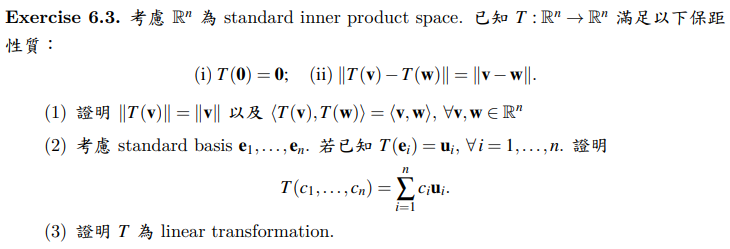
(2) 參考解答
令 $\mathbf{c}=(c_{1},...,c_{n})$
則 $\mathbf{c}=c_{1}\mathbf{e_{1}}+...+c_{n}\mathbf{e_{n}}且c_{i}=\frac{\left<\mathbf{c},\mathbf{e_{i}}\right>}{\left\|\mathbf{e_{i}}\right\|^{2}}$ 且由 (1)知 $\left<\mathbf{c},\mathbf{e_{i}}\right>=\left<T(\mathbf{c}),T(\mathbf{e_{i}})\right>且\left\|\mathbf{e_{i}}\right\|=\left\|\mathbf{u_{i}}\right\|\forall i\in {1,...,n}$
注意到由(1),$\left<\mathbf{u_{i}},\mathbf{u_{j}}\right>=\left<T(\mathbf{e_{i}}),T(\mathbf{e_{j}})\right>=\left<\mathbf{e_{i}},\mathbf{e_{j}}\right>=0 ,\forall i,j\in {1,...,n} 且 i\neq j$
故 $\mathbf{u_{1},...,u_{n}}$ 為 $\mathbb{R}^{n}$ 的一組 orthogonal basis,因此我們有 $T(\mathbf{c})=\frac{\left<T(\mathbf{c}),\mathbf{u_{1}}\right>}{\left\|\mathbf{u_{1}}\right\|^{2}}\mathbf{u_{1}}+...+\frac{\left<T(\mathbf{c}),\mathbf{u_{n}}\right>}{\left\|\mathbf{u_{n}}\right\|^{2}}\mathbf{u_{n}}=\frac{\left<\mathbf{c},\mathbf{e_{1}}\right>}{\left\|\mathbf{e_{1}}\right\|^{2}}\mathbf{u_{1}}+...+\frac{\left<\mathbf{c},\mathbf{e_{n}}\right>}{\left\|\mathbf{e_{n}}\right\|^{2}}\mathbf{u_{n}}=\sum_{i=1}^{n}c_{i}\mathbf{u_{i}}$
故得證。

(2)另解參考
$1^\circ$ 已知: $\|T(v)\| = \|v\|$, $\|T(v) - T(w)\| = \|v - w\|$。$T(e_i) = u_i$, $\{e_1, e_2, \dots, e_i, \dots, e_n\}$ 是 $\mathbb{R}^n$ 的 standard basis。
---
$2^\circ$ 由 (1) 知 $\langle u_i, u_j \rangle = \langle T(e_i), T(e_j) \rangle = \langle e_i, e_j \rangle$,因此 $\{u_1, u_2, \dots, u_i, \dots, u_n\}$ 也是 $\mathbb{R}^n$ 的一組 orthonormal basis。
---
$3^\circ$ 若 $T(c_1, \dots, c_n) = \sum_{i=1}^{n} c_i u_i$,那麼應該滿足:
將上式平方並展開:
(令 $c = (c_1, \dots, c_n)$ 是 $\mathbb{R}^n$ 上的任意向量)
其中:
① 因 $\|T(c)\| = \|c\|$,故:
② 對於 $\langle T(c), \sum_{i=1}^{n} c_i u_i \rangle$,知道 $c_i$ 是常數,利用性質 $\langle u, rv \rangle = r \langle u, v \rangle$:
又 $u_i = T(e_i)$,故:
依定義 $c = \sum_{i=1}^{n} c_i e_i$,$ \langle c, e_i \rangle = c_i$,因此:
③ 因已知 $\{u_1, \dots, u_n\}$ 也是 $\mathbb{R}^n$ 上的 orthonormal basis:
綜上,原式可寫成:
得證 $T(c_1, \dots, c_n) = \sum_{i=1}^{n} c_i u_i \ \#$

(3) 參考答案
由 (2) 已知,若 $c=(c_1,\dots,c_n)$,則
\[
T(c)=\sum_{i=1}^n c_i u_i.
\]
現取任意
\[
x=(x_1,\dots,x_n),\qquad y=(y_1,\dots,y_n),
\]
以及純量 $\alpha,\beta$。則
\[
\alpha x+\beta y
=
(\alpha x_1+\beta y_1,\dots,\alpha x_n+\beta y_n).
\]
由 (2) 得
\[
T(\alpha x+\beta y)
=
\sum_{i=1}^n (\alpha x_i+\beta y_i)u_i
=
\alpha\sum_{i=1}^n x_i u_i+\beta\sum_{i=1}^n y_i u_i.
\]
再由 (2),
\[
\sum_{i=1}^n x_i u_i=T(x),\qquad \sum_{i=1}^n y_i u_i=T(y).
\]
因此
\[
T(\alpha x+\beta y)=\alpha T(x)+\beta T(y).
\]
故 $T$ 滿足線性映射定義,所以 $T$ 是 linear transformation。
\[
\boxed{T\text{ is linear.}}
\]
(1) 參考解答
(a) 由 (i),(ii) 令 $\mathbf{w}=\mathbf{0}$ 便得 $\left\|T(\mathbf{v})\right\|=\left\|T(\mathbf{v})-T(\mathbf{0})\right\|=\left\|\mathbf{v}-\mathbf{0}\right\|=\left\|\mathbf{v}\right\|$
(b) $\forall\mathbf{v},\mathbf{w}\in \mathbb{R}^{n}$
由餘弦定理,$\left\|T(\mathbf{v})-T(\mathbf{w})\right\|^{2}$ $=\left\|T(\mathbf{v})\right\|^{2}+\left\|T(\mathbf{w})\right\|^{2}-$ $2\left<T(\mathbf{v}),T(\mathbf{w})\right>$,$\left\|\mathbf{v}-\mathbf{w}\right\|^{2}$ $=\left\|\mathbf{v}\right\|^{2}+\left\|\mathbf{w}\right\|^{2}-$ $2\left<\mathbf{v},\mathbf{w}\right>$
由 (ii),(a) 得 $\left<T(\mathbf{v}),T(\mathbf{w})\right>=\frac{-1}{2}(\left\|T(\mathbf{v})-T(\mathbf{w})\right\|^{2}-\left\|T(\mathbf{v})\right\|^{2}-\left\|T(\mathbf{w})\right\|^{2})=\frac{-1}{2}(\left\|\mathbf{v}-\mathbf{w}\right\|^{2}-\left\|\mathbf{v}\right\|^{2}-\left\|\mathbf{w}\right\|^{2})=\left<\mathbf{v},\mathbf{w}\right>$
故得證。